AI Overviews SEO is not a separate discipline: Google states that there are no extra requirements to appear in AI Overviews or AI Mode – a page must simply be indexed and eligible to show with a snippet in regular Search. What changes is the kind of content that gets picked: clear, specific, well-structured answers from sites that Google already trusts for the topic.
For niche site owners this matters a lot. AI Overviews sit above the classic blue links, and they can either take your clicks or send you new, highly qualified visitors. This guide explains how AI Overviews choose sources, what Google officially recommends, and a practical checklist you can apply to a niche site today.
What are AI Overviews and AI Mode?
AI Overviews are AI-generated summaries shown at the top of some Google results pages, with links to the web pages they are based on. AI Mode is a separate, conversational search experience where users can ask follow-up questions.
According to Google’s documentation AI features and your website, both features may use a “query fan-out” technique: the system runs several related searches across subtopics and data sources to build the answer. That is why a page can be cited for a question it was never directly optimized for – it answers one of the sub-questions well.
Google also notes that AI Overviews are only shown when its systems decide they add value beyond classic results, so many queries never trigger them.
How AI Overviews SEO differs from classic SEO
| Area | Classic SEO | AI Overviews SEO |
|---|---|---|
| Goal | Rank a page for a keyword | Be one of the sources the answer is built from |
| Unit of content | The whole page | A passage that answers one specific sub-question |
| Query type | Short head and mid-tail keywords | Long, conversational questions and follow-ups |
| Technical requirements | Crawlable, indexable, fast | The same – no extra requirements |
| Measurement | Clicks, impressions, position | Included in total Search traffic in Search Console |
In other words, AI Overviews SEO is classic SEO done with more precision: every section of your article should be able to stand on its own as a direct answer.
What Google officially recommends
Google’s guidance on succeeding in AI search and its AI optimization guide boil down to a few points:
- Focus on unique, satisfying, people-first content, not content made only to rank.
- Make sure Googlebot can crawl the page (robots.txt, server availability) and that important content is in text form.
- Provide a good page experience on all devices.
- Keep structured data consistent with the visible content.
- Support text with high-quality images and video where they help the user.
Notice what is missing: there is no special markup, file or tag for AI Overviews. Anyone selling an “AI Overviews plugin” is selling something Google does not require.
AI Overviews SEO: a practical checklist for niche sites
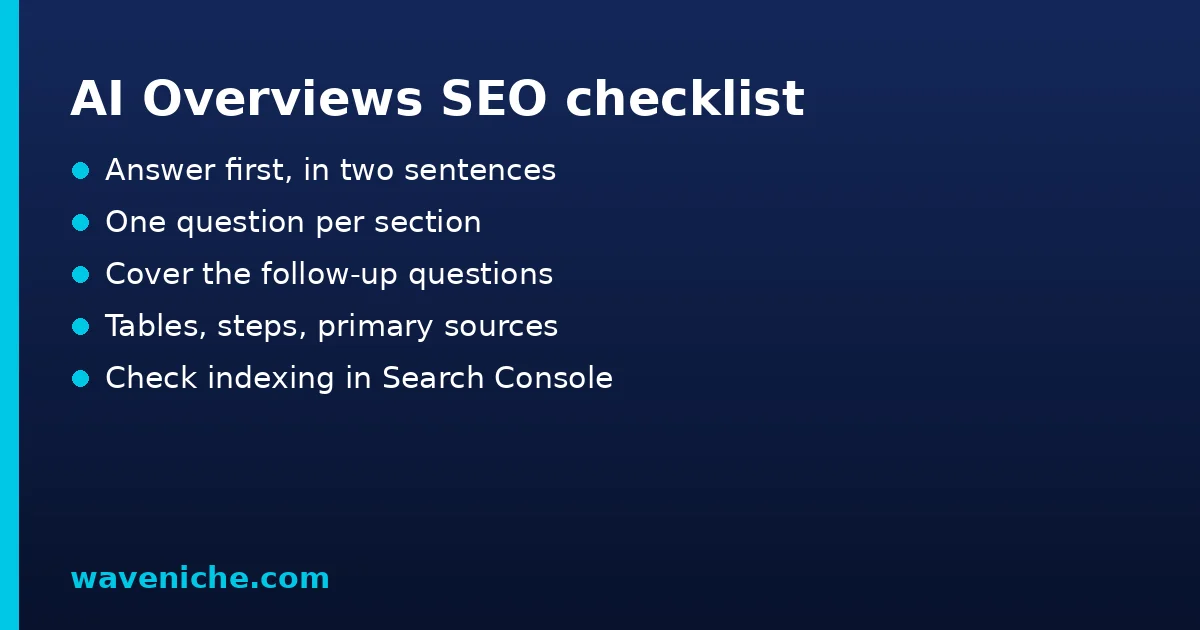
At Wave Niche we write about niche websites, SEO and monetization, and we apply the same checklist to our own articles. These are the steps that make a page easier to use as a source:
- Answer first. Put a two-sentence direct answer at the top of the article. AI systems and readers both look for it.
- One question per section. Use H2 and H3 headings phrased as the questions people actually ask, and answer each in the first paragraph under it.
- Cover the fan-out. List the follow-up questions a reader would have (cost, steps, risks, alternatives) and answer each one on the page.
- Add specifics. Definitions, steps, tables and comparisons are easier to cite than general text.
- Cite primary sources. Link to official documentation, laws and studies, not to other blogs.
- Show who is writing. An author or brand page that explains your experience helps readers and supports trust.
- Use structured data correctly. FAQ and Article markup must match the visible text. See our guide to structured data in SEO.
- Update instead of duplicating. Refresh old articles with current facts rather than publishing a new page on the same topic.
- Check indexing. A page that is not indexed cannot appear anywhere. Use the URL Inspection tool – our Google Search Console guide shows how.
Which content formats earn citations
When you look at the pages cited in AI answers for questions in your niche, you will usually find the same patterns. The formats below are the ones worth building into every article:
- Definitions. A one- or two-sentence explanation of a term, right under a heading that names it.
- Numbered steps. Processes such as “how to set up”, “how to fix”, “how to choose”.
- Comparison tables. Option A vs option B, with clear criteria in the first column.
- Pros and cons. Balanced lists help a summary show both sides.
- Problem – cause – fix. Troubleshooting tables are easy to quote and genuinely useful.
- First-hand notes. What you observed when you tested a tool or method yourself – the part a generic summary cannot produce.
None of these are tricks. They are simply the clearest way to present information, which is why they work for both readers and machines.
Which niches feel the impact most
Not every niche is affected in the same way. As a rule of thumb:
| Type of query | Impact on clicks | Strategy |
|---|---|---|
| Simple facts and definitions | High – the answer is often shown directly | Use these pages to build topical authority, not to earn revenue |
| How-to and troubleshooting | Medium – users still click for details | Go deeper than the summary: screenshots, edge cases, examples |
| Comparisons and “best” lists | Medium – users want to verify | Show your own testing criteria and update often |
| Tools, templates, calculators | Low – a summary cannot replace a tool | Build interactive assets around your core topic |
| Local and transactional | Low to medium | Combine with local SEO and clear offers |
For a niche site this means a healthy mix: informational articles to cover the topic, plus pages that offer something a summary cannot – tools, data, downloadable checklists or detailed reviews.
How to measure traffic from AI Overviews
Google states that clicks and impressions from AI features are included in the overall Search performance report in Search Console. There is no separate filter for them in the standard report, so the practical approach is:
| What to watch | Where | What it can mean |
|---|---|---|
| Long, question-like queries | Search Console → Queries | Fan-out and conversational searches |
| Impressions rise, CTR falls | Search Console → Pages | An answer is shown above your result |
| Visits from AI assistants | GA4 → Traffic acquisition | Referrals from chat assistants (GA4 may group them in a separate channel) |
| Time on page from search | GA4 → Pages and screens | Whether visitors who click find more than the summary gave them |
A 30-day AI Overviews SEO plan for an existing niche site
- Week 1: export your top 50 pages by impressions from Search Console and mark which ones answer the main question in the first paragraph.
- Week 2: rewrite the introductions and headings of the 10 pages with the most impressions and the lowest CTR.
- Week 3: add tables, steps and FAQ sections where they genuinely help, and check that structured data matches the text.
- Week 4: compare queries, clicks and CTR with the previous period, and repeat with the next 10 pages.
Common problems and fixes
| Problem | Likely cause | Fix |
|---|---|---|
| Page ranks but is never cited | The answer is buried deep in long text | Add a direct answer and question-style headings |
| Impressions but almost no clicks | The summary fully answers the question | Offer what a summary cannot: tools, templates, data, examples |
| Competitors are cited for your topic | Their pages cover more sub-questions | Map the follow-up questions and cover them |
| Old article loses traffic | Outdated facts and years in the title | Update facts, date and examples |
Does AI Overviews SEO still pay for AdSense sites?
For ad-supported niche sites the honest answer is: it depends on the query. Simple fact questions are increasingly answered on the results page. Queries that need comparison, step-by-step help, tools or personal experience still send clicks. That is why we recommend building niche content around problems, not trivia – and diversifying monetization with affiliate offers and your own products. Our article on using AI for SEO tasks covers how to speed up that work without losing quality.
Frequently asked questions
Do I need special markup to appear in AI Overviews?
No. Google says there are no additional technical requirements. The page must be indexed and eligible to appear with a snippet in Google Search.
Can I stop my site from appearing in AI Overviews?
Google provides snippet controls such as nosnippet and max-snippet, which also apply to AI features. Google has also announced a Search Console control in testing for some site owners.
Is traffic from AI Overviews shown in Search Console?
Yes. It is included in the overall Search performance report, without a separate filter in the standard view.
Does structured data help with AI Overviews?
Structured data helps Google understand the page, but it must match the visible content. It is not a ticket into AI Overviews on its own.
What content is most likely to be cited?
Clear, specific and well-structured answers from pages that cover the topic and its follow-up questions in depth.
Want more practical SEO for niche sites? Start with our SEO guide for beginners.